Why 2026 Is the Year AI Agents Stop Being Demos and Start Becoming Businesses
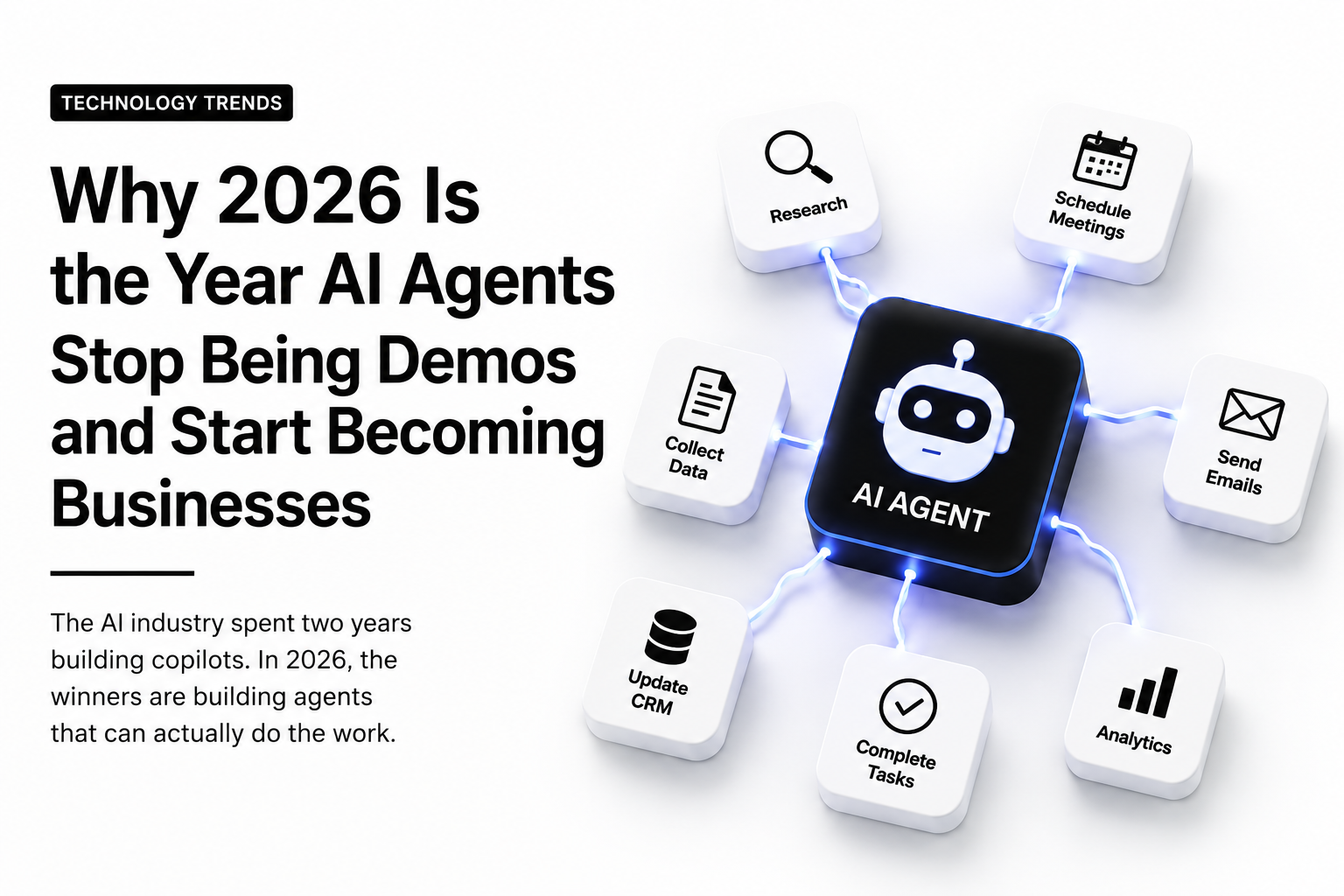
The AI industry spent two years building copilots. In 2026, the winners are building agents that can actually do the work.
Team Ktisis
Product engineers, New Delhi
For the last three years, the artificial intelligence conversation has been dominated by a single fundamental question: What can AI generate? Text, images, code, and videos flooded the web as generative models matured. But that question is rapidly giving way to a far more consequential inquiry: What can AI actually execute?
The AI industry is undergoing a structural transition from pure content generation to autonomous execution. This shift from passive assistance to active execution is creating the most significant startup opportunities of the current decade.
From Generation to Execution
Most first-generation AI tools were purely reactive. A human user provided a prompt, and the model returned text or code. While useful, these tools remained entirely dependent on constant human oversight and step-by-step guidance.
Agentic AI fundamentally transforms this paradigm. Rather than merely responding to isolated prompts, AI agents reason through complex objectives, interact directly with software interfaces, query databases, execute API calls, and complete multi-step business workflows with minimal human supervision.
The Shift to Agentic AI
- The operational distinction between chatbots and agents is profound:
- Chatbots answer queries and draft text.
- AI Agents execute end-to-end workflows and deliver outcomes.
- Consider these practical real-world applications:
- Sales Execution Agents: Autonomous systems that discover prospects, research company data, draft personalized communications, update CRM records, handle routine inquiries, and schedule sales calls.
- Talent Acquisition Agents: Intelligence layers that source qualified candidates, evaluate technical portfolios, coordinate interview schedules, and maintain candidate communication pipelines.
- Customer Success Agents: Systems that monitor usage analytics to detect churn risks and execute retention workflows before customers disengage.
Integration: Connecting Intelligence to Work
During 2024 and 2025, many AI agent projects were confined to impressive product demonstrations because they lacked systemic integration. An AI agent is only as powerful as its access to operational environments: enterprise CRMs, production databases, cloud APIs, internal messaging platforms, and legacy software.
Recent developments in standardized protocols and model context APIs have unlocked seamless integration. AI agents are moving out of sandboxed chat interfaces and directly into core business operations.
Focused Models Over Massive Generalists
A critical shift is also occurring at the model layer. Many teams initially assumed that larger parameters automatically yielded superior products. That assumption is being replaced by specialized, domain-specific models engineered for specific operational tasks.
A focused model tailored to a specific domain runs faster, costs significantly less, and delivers higher reliability than a massive general-purpose model. For emerging startups, this levels the playing field—competing in AI no longer requires building trillion-parameter foundation models.
The Emerging Infrastructure Economy
The rise of autonomous agents is birthing an entirely new infrastructure stack. Just as cloud infrastructure created AWS and mobile created app store economies, agentic AI demands dedicated tooling: agent orchestration frameworks, observability suites, persistent memory layers, safety guardrails, and governance tools. Many of the most valuable software platforms of the next decade will be the silent infrastructure powering millions of autonomous background agents.
Workflow Strategy as the True Moat
The key takeaway for founders and technical leaders is clear: the winning AI startups will not prevail simply because they possess a slightly better model. They will win because they understand domain workflows deeper than anyone else.
Most organizations do not need a generic AI strategy; they need an explicit workflow strategy. The critical question to answer is: What multi-step business processes remain manual today, and how can software complete them end-to-end? That is where the next generation of category-defining software will be built.
Related Insights
View AllKtisisLabs: Your Product Engineering Partner
Build your startup product without building an extensive engineering team — product strategy, technical leadership, and lean senior engineering focused on business outcomes.
Read Artificial IntelligenceIndia’s AI Renaissance: Building the Future at Scale
How India is rapidly emerging as a global AI powerhouse through innovation, infrastructure, and ambitious startups.
Read